
Reading While Naked
What does Feminist Liberation Theology and reading Jane Eyre have in common?

Hi friends,
I have been a part of the same book club for over a decade. I haven’t always been consistent, but I wonder if that’s the secret to how things last, consistently inconsistent? Anyway, I just finished our book for this month, The Secret Book Society by Madeline Martin, an enjoyable, easy read that will also make your feminine soul blaze like the lavic-center of the earth.
A quick recap without any spoilers
Set in the late Victorian era, a wealthy widow recruited a few women from society whom she felt needed to be liberated from their circumstances, one of which was that none of them were allowed to read literature or poetry. Instead, they were only permitted to read books on Household Management about domestic tasks or morally instructive texts like the Bible.
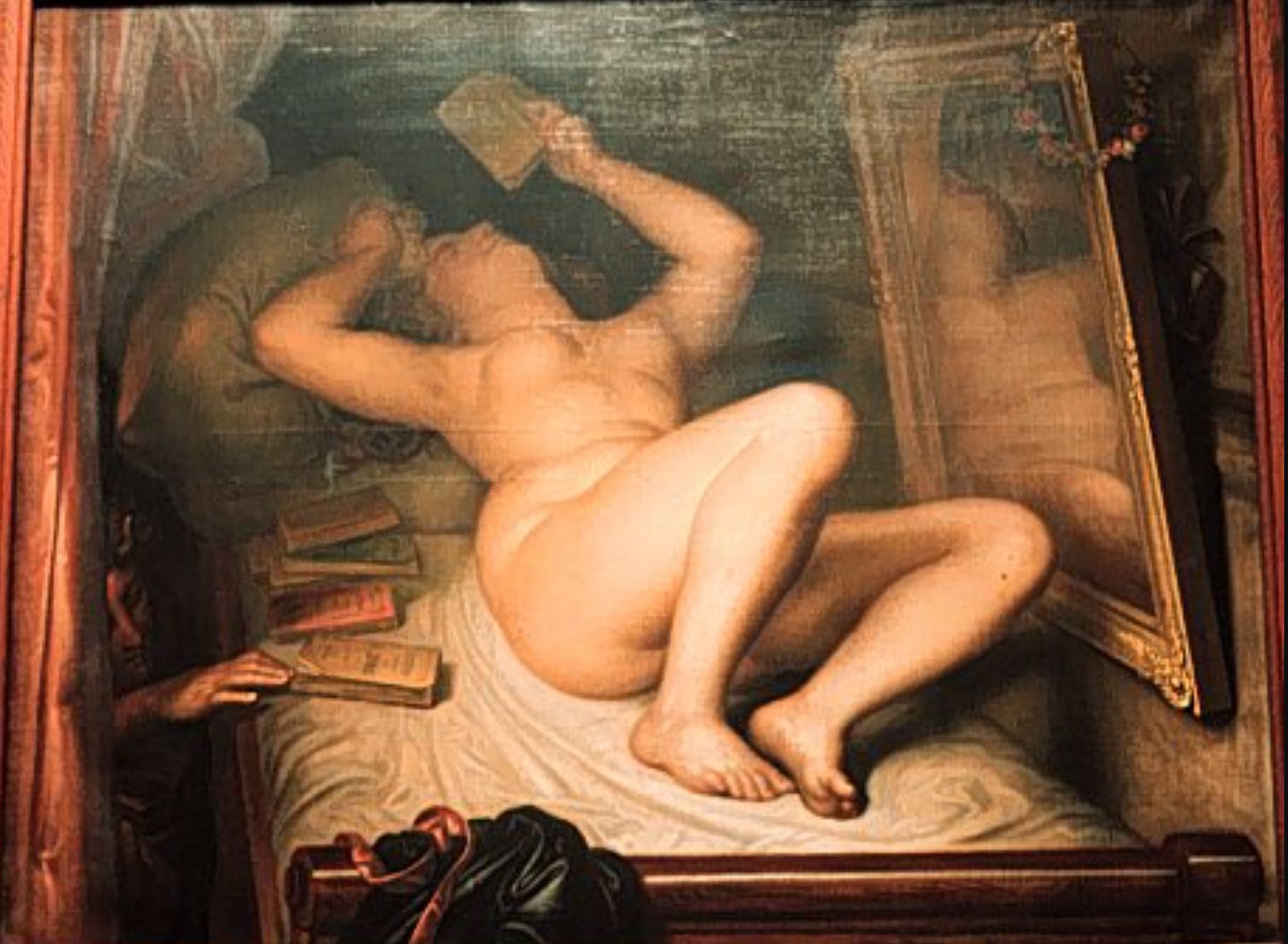
During that time period, it was believed that women reading literature led to all sorts of unadmirable traits like melancholy, promiscuity, and even hysteria. This ideology is well illustrated in the 1853 painting The Reader of Novels by Antoine Wiertz, showing a woman reading naked. Who knew Jane Eyre could be so scandalous?! But her words pushed against the norm.
“I can live alone, if self-respect, and circumstances require me so to do. I need not sell my soul to buy bliss. I have an inward treasure born with me, which can keep me alive if all extraneous delights should be withheld, or offered only at a price I cannot afford to give.” - Charlotte Brontë, Jane Eyre
One thing to note about this point in history is that it became common practice for husbands to admit their wives to insane asylums if they became dissatisfied with their performance as a wife or mother, or if they exhibited undesirable behaviors (like thinking for themselves). And what occurred in those asylums is absolutely abhorrent.
I have also been reading a hefty text, She Who Is: The Mystery of God in Feminist Theological Discourse by the esteemed Catholic theologian, Elizabeth Johnson, alongside my friends Anni Ponder and Kim Eckhart. Johnson’s work is challenging the androcentric1, male-dominant narrative of God through the lens of liberation feminist theology. She begins her research by asking a very critical question: What is the right way to speak about God?
This is a question of unsurpassed importance, for speech to and about the mystery that surrounds human lives and the universe itself is a key activity of a community of faith. In that speech the symbol of God functions as the primary symbol of the whole religious system, the ultimate point of reference for understanding experience, life, and the world.2
She goes on to say that the way a community decides to speak about God ultimately shapes the corporate identity and its practices. Basically, our language shapes our theology, communities, and practices, and to this day our male-dominant language of the Divine has “wittingly or not…undermines women’s human dignity as equally created in the image of God.”3

Though I have been reading feminist literature for quite some time, I can’t escape the experience of feeling a bit naked with each new encounter. With every chapter, poem, or story I read, another restrictive article of patriarchy is removed, illuminating the skin to the fresh air of liberation.
Such an undressing is cause to celebrate my femaleness in all its curves and angles as an appropriate image for the Divine. It is also a cause to continue the work, to not let the voices of women like Elizabeth Johnson, Charlotte Brontë, Madeline Martine, and Carol Lynn Pearson be forgotten.

She is present but not accounted for
and the only crime committed was not
a crime against Her but a crime

against humanity Her family, a crime
committed by humanity Her family.

Her name was stolen
but what’s in a name?

We could eat bread if it had no name
but it would be harder to ask for?

And how lovely it is to know that
my daily bread bears Her aroma
and to know that all my blessings flow
through Her hands as well as His.

-A excerpt from "The Case of the Disappearance of God the Mother" by Carol Lynn Pearson

Feminist writers and theologians aren’t anti-men, just anti-ideologies that produce and uphold oppressive systems. We need a balanced discourse. We need expansive metaphors and symbols for God. And yet to do this, the scales have to tip towards liberation, and that starts with reading our words, receiving our stories, and taking our experience seriously.
It might even take a little hysteria fueled by the scandalous enjoyment of a good book.
And there’s plenty out there.
Here are just a few, in no particular order (all non-Amazon links).
Dance of Dissident Daughter by Sue Monk Kidd (Memoir)
When Women Were Dragons by Kelly Barnhill (Fiction)
The Once and Future Witches by Alix E. Harrow (Fiction, and don’t even get me started on how certain women were labeled “witches” - that’s for another essay)
She Who Is by Elizabeth Johnson (Bible & Theology)
In the Beginning Were the Women by Claire McKeever-Burgett (Theology, Story, Spiritual Practice)
Finding Mother God by Carol Lynn Pearson (Poetry)
Love like a Mother by Elizabeth Berget (Biblical images of God as Mother; story)
When God Was a Woman by Marlin Stone (Women's Studies and Anthropology)
The Swallow’s Nest: A Feminine Reading of the Psalms by Marchiene Vroon Rienstra and Marchiene V. Reinstra (Devotional)
What book would you add to this list? Comment below.

Happy reading, my friends.

The practice of putting male perspectives at the center of how we view the world.
Johnson, Elizabeth: She Who Is: The Mystery of God in Feminist Theological Discourse. 1992. Pg. 4
Johnson, Elizabeth. Pg. 5
Love this Colette. 💕
This is such a great list of books! Some, I've read and loved, and others, I want to read. I just finished reading Circe, by Madeline Miller, a feminist retelling of many of the Greek myths. I loved it!