
The Blue Lines
Learning to read the river beneath the roads

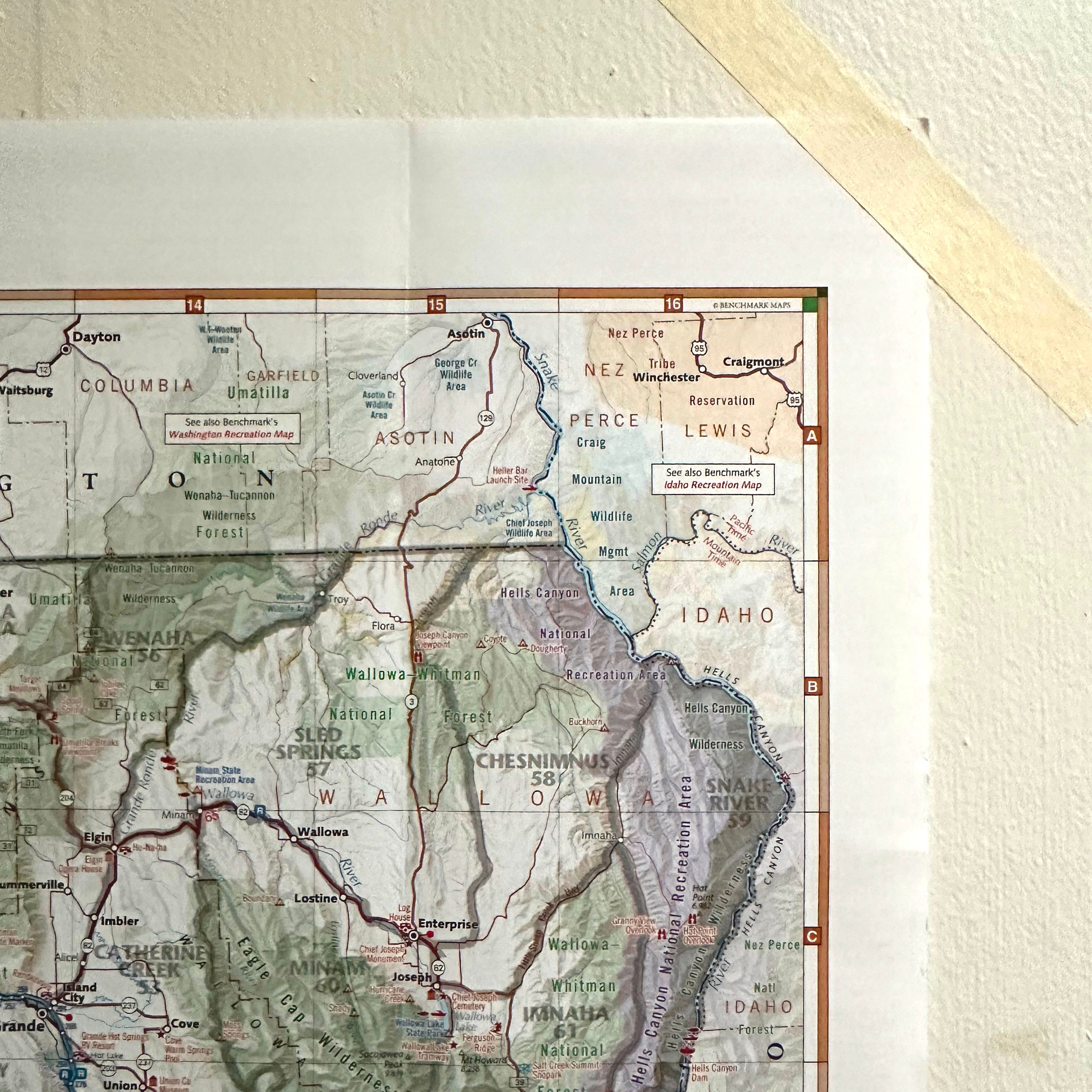
I stumbled through the unfolding of the only paper map of Oregon I could find, bending and swirling my arms in some strange, unfamiliar pattern, carefully uncreasing each fold to keep from tearing the fragile paper. I stood in the bookstore aisle, almost expecting applause after a successful first try, but my pride quickly faded when I attempted to refold it back to its original shape.
I was disappointed to find that there weren’t many maps to choose from, as “most people just use their phones,” the clerk explained. But you can’t see the whole of Oregon from a 3 x 6-inch screen, which led me on the hunt for paper. After the successful unfolding, I could see it all. The valleys, mountains, rivers, and streams. All in light colors of blues and browns. You have to strain your eyes to see them past the black lines of freeway and roads clearly marked, but the rivers are there. They’ve always been there.
I know many of those freeways and roads by heart. I could tell you, without the use of my phone, how to get to City Center. I could give you directions to the best restaurant in Hood River, or a favorite winery in the Willamette Valley. But can I tell you how to get to the Tualatin or the Clackamas Rivers? I’d have to use Google Maps for that.
We spend much of our lives on the road, familiar with all the turns and stops along the way. I actually hate driving. If I could walk, I would, but my way of life includes asphalt and stop lights. It’s like the barely visible blue line marking a stream on my Oregon map reveals my own disconnection from the land I drive over every day.
I’ve been reading about rivers lately, and this sentence has stuck with me:
Just as we humans are products of our backgrounds and experiences so is each stream a product of its watershed and the geology that shapes it.1
Every river has an origin story - its watershed. Where the water came from will determine its course and behavior. Some watersheds are shallow, lacking structure - with heavy rain, flooding will occur, and with dry weather, drought. Other watersheds are deep wells, rocky and rich, offering consistent flow and temperature.
My origin story feels like a mix of shallow and rich - the Industrial Revolution, with its roads and factories, but it is also Alaska, containing deep waters teeming with wild salmon. I still have a vivid memory of attempting to pass the “parallel parking” section of my driver’s test. I also sense the little girl, bent over a sparkling tide pool, poking at an orange starfish. I bet for most of us, we contain a multitude of watersheds. Some determine our behavior and path more than others - they are the dark lines marking out familiar roads. And yet, the light blue lines are still there, inviting us into something wild and untamed.
I wonder what life would be like if I spent more time walking along rivers than driving on roads. It’s almost laughable, a wishdream to even think it, that that could ever be a possibility. To get to a river, I have to drive there! But maybe that’s the point. We cannot change our watersheds. Our origin stories are embedded in the earth. But we can still learn to find fresh water (even though GPS might be necessary).
My Oregon map is now taped up in our hallway, slightly crooked. The more I look at it, the more light blue lines I see, directing me towards stretches of earth I have yet to explore. It makes me wonder, maybe the blue lines are closer than they appear. And maybe, just maybe, all roads will eventually lead us to the rivers.


Still learning the way to water,

Kurt D. Fauch, For the Love of Rivers, Chapter 3, pg 52
I’m looking for the blue lines underneath with you. Thanks for being a guide to return to the wild.